Front Range Passenger Rail and Joint Service
Front Range Passenger Rail and Joint Service
About Front Range Passenger Rail
Colorado is advancing a major effort to bring passenger rail to the northwest metro area and create an intercity rail corridor along the Front Range. After delays to RTD’s FasTracks Northwest Rail project, agencies are partnering on new solutions—most notably Front Range Passenger Rail (FRPR) and a collaborative starter phase known as Joint Service.
Together, these initiatives will improve mobility, expand travel options, and support a more connected and sustainable region.
Big News for Joint Service!
On April 9, 2026, the Joint Service Executive Committee announced a new agreement with BNSF Railway to bring passenger rail service from Denver to Fort Collins. This collaborative effort between state agencies and Regional Transportation District (RTD) will deliver service at nearly half the previously expected cost, with no new taxes. By using a single operator, one route, and a unified agreement with BNSF, the project streamlines operations, reduces costs, and improves coordination—advancing a more connected and efficient transportation system along the Northern Front Range.
View the term sheet and the Joint Service BNSF/CO Negotiation Update Presentation deck.
Join Us! Front Range Passenger Rail District Town Halls
As the Front Range Passenger Rail District is finalizing the Service Development Plan, the district is investing heavily in engagement to ensure that residents across the Front Range have opportunities to learn about the service vision, route, stations and funding options and weigh in on the plan.
As part of their engagement phase, Commuting Solutions has signed on to host and facilitate three town halls across the northwest metro region. In partnership with Front Range Passenger Rail District, we are pleased to announce the following town halls:
Longmont Museum and Cultural Center
400 Quail Rd, Longmont, CO 80501
Wednesday, April 8, 2026
6:00 – 7:30 p.m.
Westminster City Hall
4800 W 92nd Ave, Westminster, CO 80031
Wednesday, April 29, 2026
6:00 – 7:30 p.m.
We encourage everyone to attend any of the town hall events, as they will cover regional information.
What to expect:
- Remarks from local leaders and elected officials
- Front Range Passenger Rail and Joint Service Overview presentation
- FRPR Station Planning Areas
- Audience Q&A
To better understand the current status of Front Range Passenger Rail, read below.
Town Hall Presentation Decks Available!
What is the Front Range Passenger Rail Project?
Front Range Passenger Rail (FRPR) is a proposed intercity passenger rail service connecting Colorado’s Front Range communities from Fort Collins to Pueblo with potential future connections north to Wyoming and south to New Mexico.
Planning and advancing the project forward is the Front Range Passenger Rail District, a public agency, created by the Colorado General Assembly in 2021 through Senate Bill 21-238.
The District’s statutory responsibility is to plan, finance, construct, operate, and maintain an intercity passenger rail system; coordinate with freight railroads, the Colorado Department of Transportation (CDOT), Regional Transportation District (RTD), and local governments; and engage the public transparently before considering any ballot decision.
Benefits of Intercity Rail
- Expands mobility and multimodal travel options
- Strengthens community and regional connections
- Supports economic vitality and transportation equity
- Advances environmental sustainability goals
Identified Communities with Rail Service
Front Range Passenger Rail (FRPR) is planned to serve communities along Colorado’s Front Range, with 13 stations spanning 11 counties and connecting major cities from Fort Collins to Pueblo, following the I-25 corridor.
Planned station communities and their counties include:
Fort Collins in Larimer County
Loveland in Larimer County
Longmont in Boulder and Weld counties
Boulder in Boulder County
Louisville in Boulder County
Broomfield in Broomfield County
Westminster in Adams and Jefferson counties
Denver in Denver County
Littleton in Arapahoe County
Douglas County
Colorado Springs in El Paso County
Pueblo in Pueblo County
Trinidad in La Animas Count (currently planned just construction of a station on their existing Southwest Chief line)

Map Description
This graphic is a vertically oriented map of Colorado highlighting the Front Range Passenger Rail (FRPR) District corridor. The map focuses on the Interstate 25 (I-25) corridor running north to south through the eastern side of the Rocky Mountains.
A light blue shaded region indicates the FRPR District boundary. The shaded area forms a long, narrow band that follows I-25 from the Wyoming border in the north to Trinidad near the New Mexico border in the south. The shaded region widens around major metropolitan areas, particularly the Denver metro area and Colorado Springs.
A black rail line with cross ties (indicating freight rail track) runs continuously north–south through the shaded corridor, generally parallel to I-25. Circular yellow markers with black outlines identify key station cities along this rail line.
From north to south, labeled cities include:
- Fort Collins
- Loveland
- Longmont
- Boulder (slightly west of the main I-25 corridor)
- Denver
- South Metro
- Castle Rock
- Colorado Springs
- Pueblo
- Trinidad
Each city label appears inside a white rectangular box with a black border, connected by a black leader line to its corresponding yellow station marker on the rail line.
Major highways are shown with standard interstate shields and route markers, including:
- I-25 running north–south through the entire corridor.
- I-70 running east–west through Denver.
- I-76 branching northeast from Denver.
- E-470 (beltway) east of Denver.
- U.S. Highways 36, 85, and 119 in the northern Front Range.
Airports are indicated with small airplane icons near:
- The northern Front Range (near Fort Collins/Loveland area),
- The Denver metro area,
- Colorado Springs,
- Pueblo.
County boundaries are shown in thin gray lines across the state. Populated areas are shaded in light gray clusters, concentrated along the Front Range urban corridor.
Two gray callout boxes indicate future rail connections:
- Near the top right: “Future Connections to Wyoming.”
- Near Pueblo: “Future Connections to Trinidad and New Mexico.”
A north arrow appears in the upper left corner indicating map orientation.
In the lower left corner, a legend explains map symbols:
- Light blue shading: FRPR District
- Railroad track symbol: Freight Rail Track
- Double line: Major Highway
- Airplane icon: Airport
- Thin outlined shapes: Counties
- Gray shaded areas: Populated Areas
Overall, the map visually emphasizes a proposed or planned passenger rail corridor running along existing freight rail infrastructure parallel to I-25, connecting major Front Range cities from Fort Collins to Trinidad, with potential extensions north into Wyoming and south into New Mexico.
Service Development Plan
The Service Development Plan is the federally recognized blueprint for the rail service. It defines the Front Range Passenger Rail route, station locations at a planning level, service frequency, travel times, infrastructure needs, and capital and operating cost ranges. Completion of the Service Development Plan is required to advance federal approvals, environmental review, and funding.
The Service Development Plan is nearing completion and is undergoing targeted refinements to ensure accuracy, feasibility, and coordination with partners before it is finalized for public use.
Funding and Joint Service
Front Range Passenger Rail is being planned in two distinct funding phases. The first phase focuses on launching limited early service using primarily existing funding sources and does not rely on a new tax or impose a direct cost on communities. This is called the Joint Service Plan.
Partnerships
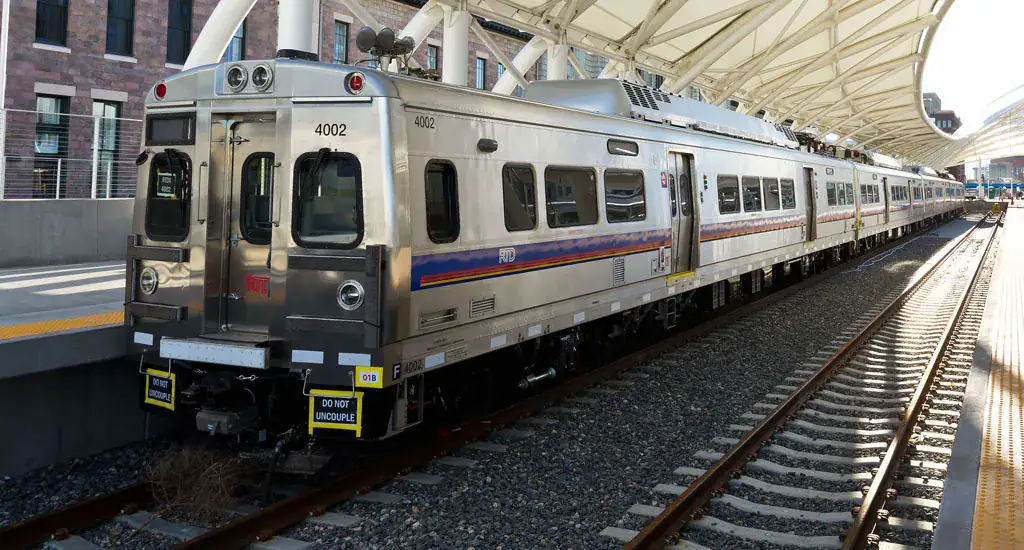
Joint Service is a partnership between the following groups to launch initial passenger rail service between Denver Union Station and For Collins by 2029:
- Colorado Department of Transportation (CDOT)
- Colorado Transportation Investment Office (CTIO)
- Regional Transportation District (RTD)
- Front Range Passenger Rail District (FRPRD)
The initial phase will operate three daily round-trip service, with opportunities to expand service as funding and ridership grow. This phased approach lays the foundation for future Full Front Range Passenger Rail.
Second Phase
The second phase addresses long-term funding needs and would proceed only with voter approval through a ballot measure. This phased approach allows early service to begin where demand is highest while ensuring that decisions about any new funding remain in the hands of voters.