Transportation Demand Management (TDM)
Transportation Demand Management (TDM)
What is TDM?
Transportation Demand Management (TDM) is a strategic approach to maximizing the efficiency of a transportation system. It focuses on optimizing mobility by making better use of transportation options that already exist. That means encouraging choices like carpooling, biking, walking, using public transit, or even shifting travel times to reduce congestion.
Why is TDM Important?
Single occupancy vehicles (SOV) take up significant space on roadways, cause excessive wear and tear on public infrastructure, and contribute significantly to greenhouse gas emissions when compared to carpooling, public transit, or cycling. With the widespread prioritization of SOVs over the past 70 years, traffic congestion has led to continued expansion of roadways, even though studies show that adding lanes does not reduce congestion.
TDM Strategies employ a two-fold approach: First, they enhance the attractiveness of non–single-occupancy vehicle (non-SOV) options by improving time efficiency, lowering costs, and increasing accessibility. Second, they lay the groundwork for robust multimodal infrastructure, including more frequent transit service, safer cycling networks, and expanded rapid transit systems.
Together, these efforts not only improve mobility for those who rely on public or active transportation but also alleviate traffic congestion for individuals who choose—or need—to drive alone.
The Many Benefits of TDM
TDM strategies aim to support every road user through infrastructure investments instead of prioritizing SOVs at the expense of everything else.
Fewer cars on the roads mean fewer vehicular crashes, less pollution, more efficient land use (less of a requirement for parking spaces).
TDM also emphasizes pedestrian infrastructure like wider sidewalks, overpasses/underpasses at busy intersections, better visibility at crosswalks, and overall safer roads.
Ultimately, TDM is about giving people mobility choices, allowing everyone to safely and efficiently travel in the way that suits them best.

How Does Commuting Solutions Advance TDM?
Commuting Solutions advances TDM strategies by collaborating with private sector partners, local jurisdictions, and service providers to enhance regional TDM implementation.
In 2024, Commuting Solutions, in collaboration with UrbanTrans North America, as well as public, private and nonprofit stakeholders led the effort to develop the Northwest Regional Transportation Demand Management (TDM) Plan [PDF, 11.35 MB] [PDF, 11.35 MB]. The plan is already garnering national attention with Commuting Solutions being named a finalist for the 2023 Association of Commuter Transportation (ACT) Excellence in Planning Award for our groundbreaking work on the plan.
Through this collaborative process, Commuting Solutions and partners identified 11 strategies that focus limited resources, services and programs on high-impact projects where there is the greatest need. We will continue to implement the plan over the coming years.

Common TDM Strategies
TDM strategies are a cost-effective way to build a transportation system that’s cleaner, healthier, and more sustainable. When TDM is part of city planning, it leads to better access for everyone—making transportation more efficient, fair, and responsive to community needs.
1. Integrate TDM Into the Built Environment
There are many strategies used to integrate TDM into the built environment, including:
- Increasing housing density and mixed land uses near transit stops and routes.
- Invest in comfortable and accessible transit stops and mobility hubs.
- Wayfinding – signs to support active transportation and transit
- Dedicated bike/scooter lanes
- Dedicated bus lanes


2. Travel Options
Other strategies involve options for travelers:
- On-site bicycle amenities (secure parking, changing rooms, etc.)
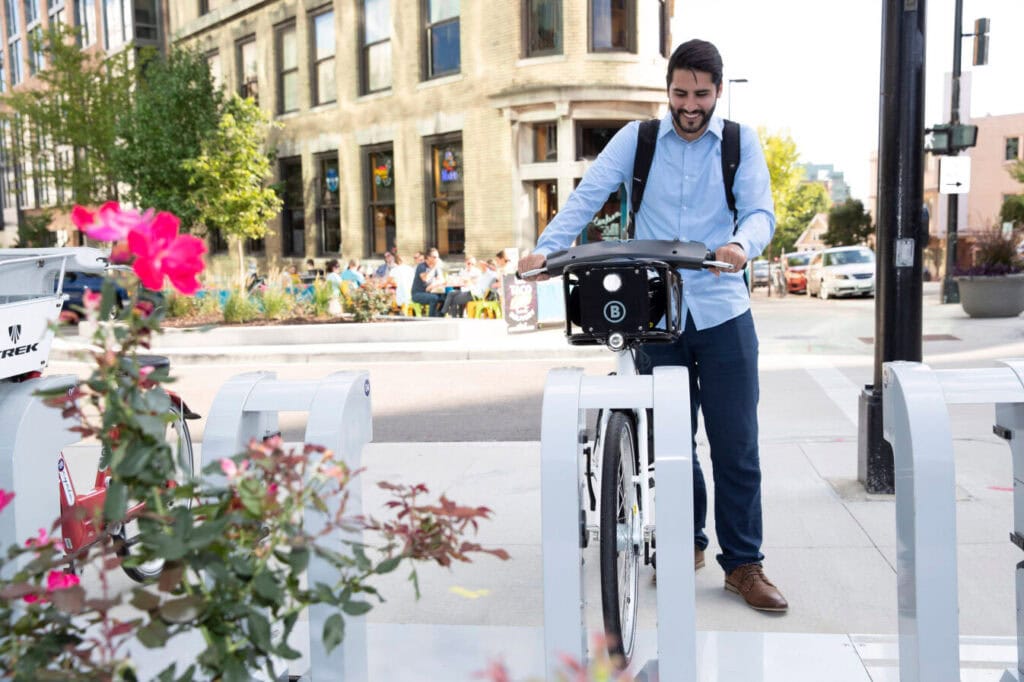
- Providing shared micromobility (bicycles, scooters)
- Facilitating carpools and vanpools
- Dedicated parking for carpools, vanpools, and car share
- Investments in fast and efficient transit such as BRT
- Providing first and final mile services to transit users (shuttle services, cycling infrastructure).
3. Incentivize Non-SOV Transportation Modes
Some strategies incentivize different transportation modes in creative ways such as:
- Parking cash-out programs
- Unbundled parking
- Shared mobility subsidies
- Shuttle service to connect facilities to high-capacity transit
- Require that large developments implement a TDM plan
Model TDM Ordinance and Developer’s Toolkit
In 2023, Commuting Solutions published the Transportation Demand Management (TDM) toolkit for Developers, and completed the Northwest Regional Transportation Demand Management (TDM) Plan. In the Northwest TDM Plan, the development of a model TDM regulation was identified as one of the eleven priority strategies for advancing TDM in the region. In collaboration with the 9 local governments in the northwest metro region, Commuting Solutions then began developing the model regulation by utilizing extensive case studies, stakeholder workshops, and developer focus groups.
The model ordinance establishes a replicable framework for advancing sustainable and equitable regional mobility and reducing single-occupancy vehicle dependency in the built environment.
If you’d like to view the Model TDM Ordinance and Developer’s Toolkit, please fill out the form below, and we’ll be happy to share these resources. If you would like to learn more about these tools, please contact Joe Josleyn, at joe@commutingsolutions.org.