RTD FasTracks / Northwest Rail
RTD FasTracks / Northwest Rail
What is FasTracks
FasTracks is the Regional Transportation District, RTD’s voter-approved expansion project — the largest in the nation — promising to build and operate high-speed commuter and Bus Rapid Transit service while also expanding and improving bus service and Park-n-Rides throughout the Denver metro region.
Since 2004, 25.1 miles of light rail track and 53 miles of commuter rail track have been constructed. The Flatiron Flyer Bus Rapid Transit (BRT) transit service was launched, and an intermodal hub was opened at Union Station in Downtown Denver.
Commuting Solutions continues to collaborate with regional partners and RTD to advocate for the completion of the Northwest Rail portion of the project.
History of FasTracks
CDOT, Front Range Passenger Rail, and the State of Colorado are also exploring a Joint Rail Service, a promising approach that would integrate commuter and passenger rail on existing freight tracks.
FasTracks was voter-approved in 2004 and includes the following commitments:
- 122 miles of new light rail and commuter rail
- 18 miles of Bus Rapid Transit (BRT) service
- 57 new transit stations
- 21,213 additional parking spaces at Park-n-Ride stations
- Enhanced bus service and FastConnects throughout the region
To date, RTD has completed about 75% of the program. However, due to funding shortfalls and the 2008 recession, the Northwest Rail line connecting Denver to Longmont remains incomplete beyond South Westminster Station.
RTD’s 2025 Finishing Fastracks Report presents a candid look at the financial challenges of completing the long-promised transit expansion. While the outlook is difficult, the report marks an essential step toward renewing momentum and charting a path forward to make the vision a reality
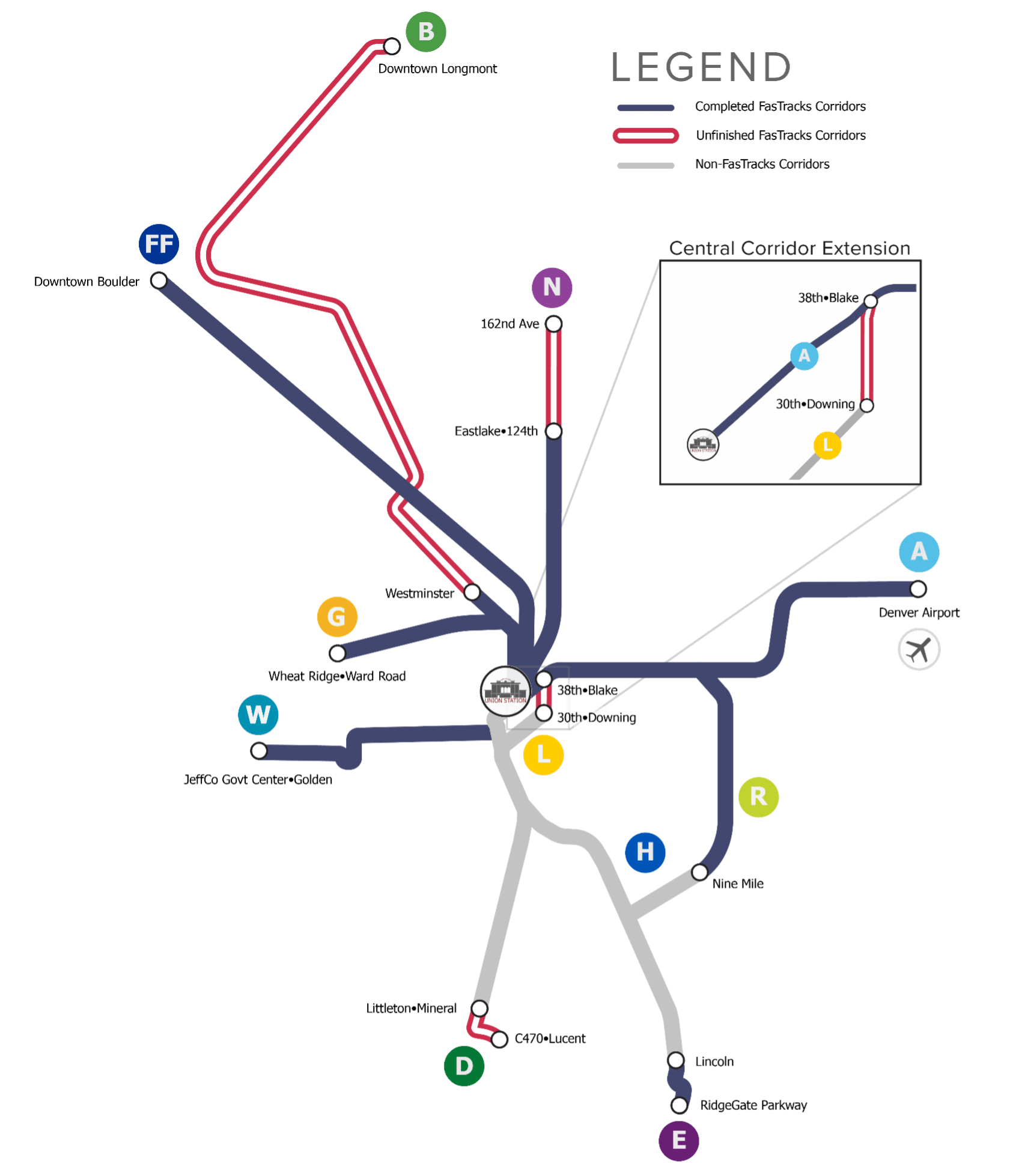
FasTracks Map Text Description
FasTracks Map Text Description
The following lines are illustrated on the RTD FasTracks Progress Map.
Completed FasTracks Corridors (dark blue):
- W – West Corridor (W Line) – Denver Union Station to Jeffco Gov’t Center, Golden – Completed 2013
- FF – US 36 Bus Rapid Transit (BRT) Flatiron Flyer – Boulder to Denver Union Station, Civic Center, Denver International Airport, and Anschutz campus – Completed 2016
- A – East Corridor (A Line) – Denver Union Station to Denver International Airport – Completed 2016
- B – Northwest Phase I (B Line) – Denver Union Station to Westminster Station) – Completed 2016
- R – I-225 (R Line) – Peoria to Lincoln – Completed 2017
- G – Gold Line (G Line) – Denver Union Station to Wheat Ridge, Ward Road – Completed 2019
- E – Southeast Extension (E Line) – Portion of E Line from Lincoln Station to RidgeGate Parkway – Completed 2020
- N – North Metro (N Line) – Denver Union Station to Eastlake, 124th – Completed 2020
Unfinished FasTracks Corridors (red outline):
- B – Northwest Rail Peak Service – Westminster Station to Downtown Longmont
- N – North Metro Corridor – Eastlake, 124th to 162nd Ave
- D – Southwest Corridor Extension – Littleton, Mineral to C470, Lucent
- L – Central Corridor Extension – 30th and Downing to 38th and Blake
Non-FasTracks Corridors (grey):
- Union Station to 30th and Downing
- Union Station to Littleton
- Union station to Lincoln Station
- Union Station to Nine Mile
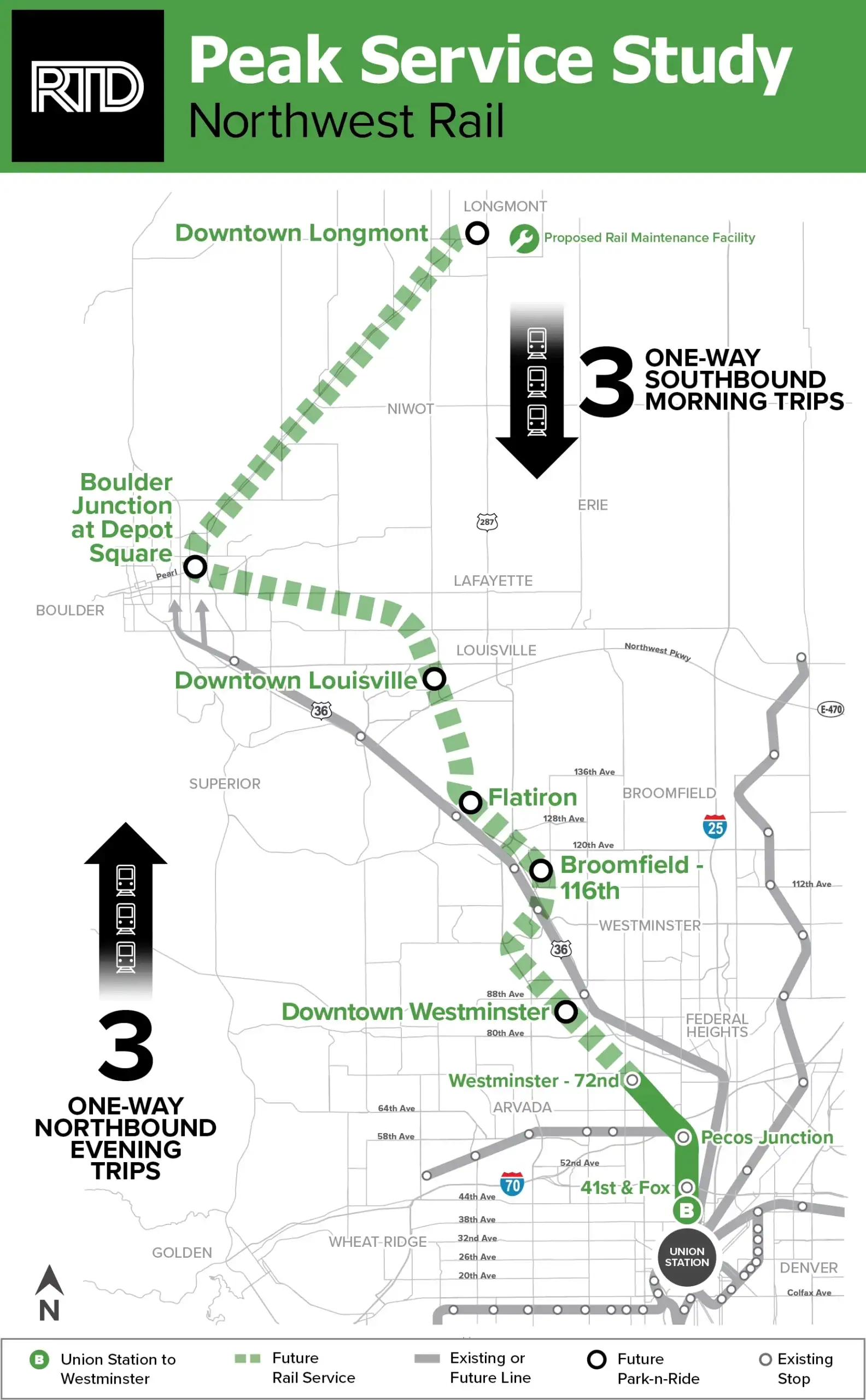
Peak Service Study Map Text Description
Peak Service Study Northwest Rail Map Text Description
The map shows 3 one-way Southbound Morning Trips and 3 one-way northbound evening trips using the following stations.
Existing Stations (4)
- Denver Union Station
- 41st & Fox (B and G lines)
- Pecos Junction (B and G lines)
- Westminster – 72nd (B Line)
Proposed Stations (6)
- Downtown Westminster
- Broomfield – 116th
- Flatiron (Broomfield)
- Downtown Louisville
- Boulder Junction at Depot Square
- Downtown Longmont
2024 Northwest Rail Peak Service Feasibility Study
In 2022, the RTD Board of Directors authorized the Northwest Rail Peak Service Feasibility Study to respond to stakeholder input on how RTD might complete it’s 2004 Fastracks Plan by assessing an initial commuter rail service plan in the Northwest Corridor.
The Peak Service concept, as defined by stakeholders and the RTD Board, consists of three trains on weekday mornings from Longmont to Denver’s Union Station and three trains on weekday evenings from Denver’s Union Station to Longmont.
The Northwest Rail Peak Service Feasibility Study aimed to identify corridor and regulatory challenges and constraints, infrastructure requirements, fleet (train vehicle) options, station site plans, platform configurations, concept designs, and the range of costs, benefits, and impacts of providing the service. The project team defined a Common Set Of Facts, which describes the mutual understanding reached in the Study between RTD, BNSF, and local stakeholders on what it would take to implement the Peak Service plan.
The final study report was published in September of 2024.